Before there were books, there were stories. Told by firelight, passed between generations, worn smooth by repetition until only the essential remained. Folk tales are the oldest form of human knowledge, not history, not instruction, but something closer to truth.
This scarf begins with one of them.
A bear is caught in a net. He thrashes, exhausts himself, and falls asleep. While he sleeps, a mouse scurries across his great body. The bear catches it. The mouse pleads: let me go, and I will repay you one day. The bear laughs, what could something so small ever offer him? But he lets it go.
Later, the mouse returns with an entire flock. Together they gnaw through every rope until the bear walks free.
The moral is ancient and undiminished: do not mistake smallness for insignificance.
Stars, a crescent moon, a sun with a face, these float through the composition as if the story is happening in mythic time rather than linear time. They are the feeling of a story told at night, in a world where the sky still meant something. Where time moved differently. Where a mouse could save a bear and no one thought it impossible.
The whole composition is held inside a checkerboard border of terracotta and blush, a frame that knows it is a frame. A threshold between the everyday and the mythic. Cross it, and you are somewhere else.
Folk art was never gallery art. It lived on bodies, on walls, on everyday objects, embroidered aprons, painted chests, printed textiles. By putting this work on a scarf, it stays true to that original logic: art that is worn, touched, carried, used. Not framed behind glass.
Before there were books, there were stories. Told by firelight, passed between generations, worn smooth by repetition until only the essential remained. Folk tales are the oldest form of human knowledge, not history, not instruction, but something closer to truth.
This scarf begins with one of them.
A bear is caught in a net. He thrashes, exhausts himself, and falls asleep. While he sleeps, a mouse scurries across his great body. The bear catches it. The mouse pleads: let me go, and I will repay you one day. The bear laughs, what could something so small ever offer him? But he lets it go.
Later, the mouse returns with an entire flock. Together they gnaw through every rope until the bear walks free.
The moral is ancient and undiminished: do not mistake smallness for insignificance.
Stars, a crescent moon, a sun with a face, these float through the composition as if the story is happening in mythic time rather than linear time. They are the feeling of a story told at night, in a world where the sky still meant something. Where time moved differently. Where a mouse could save a bear and no one thought it impossible.
The whole composition is held inside a checkerboard border of terracotta and blush, a frame that knows it is a frame. A threshold between the everyday and the mythic. Cross it, and you are somewhere else.
Folk art was never gallery art. It lived on bodies, on walls, on everyday objects, embroidered aprons, painted chests, printed textiles. By putting this work on a scarf, it stays true to that original logic: art that is worn, touched, carried, used. Not framed behind glass.
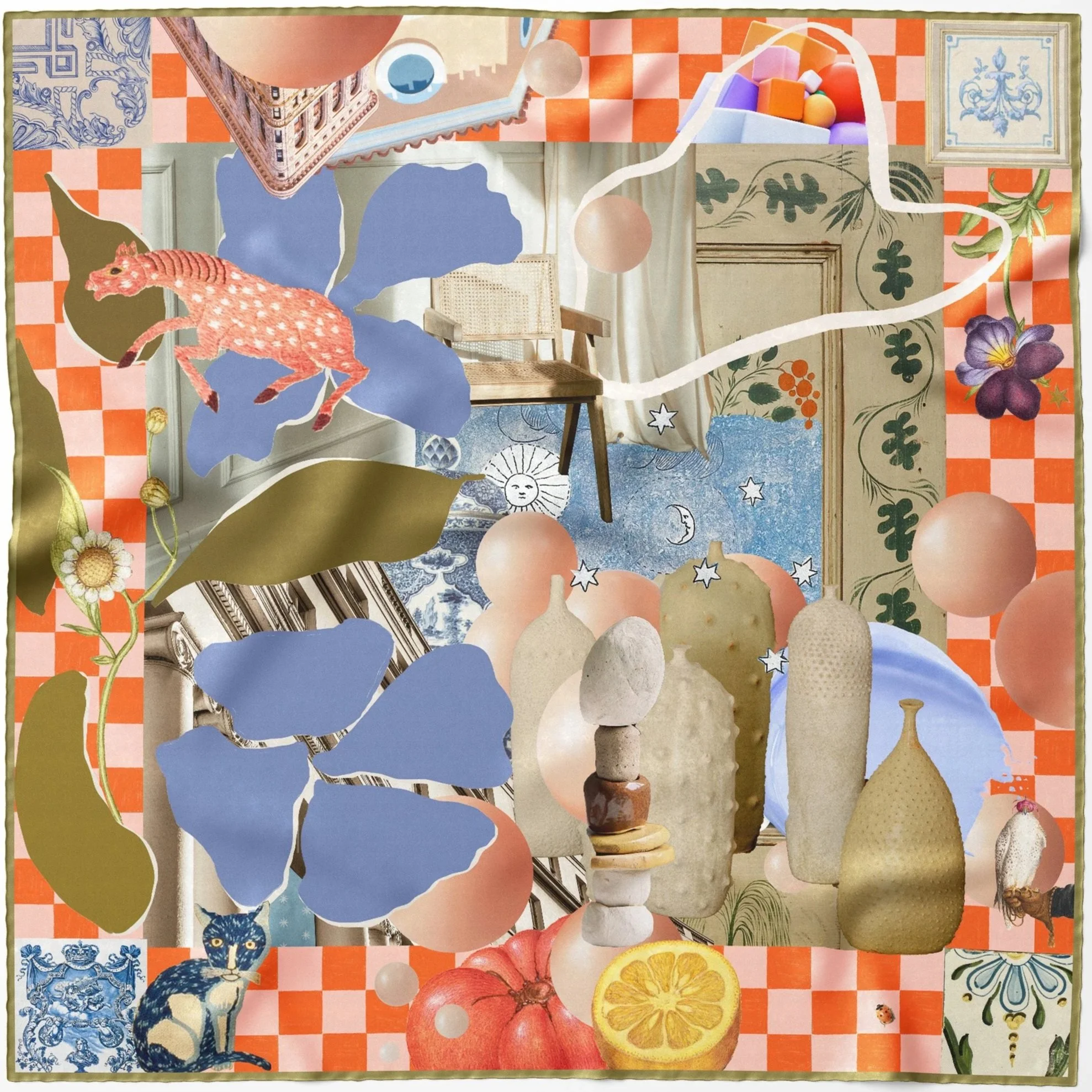 Image 1 of 2
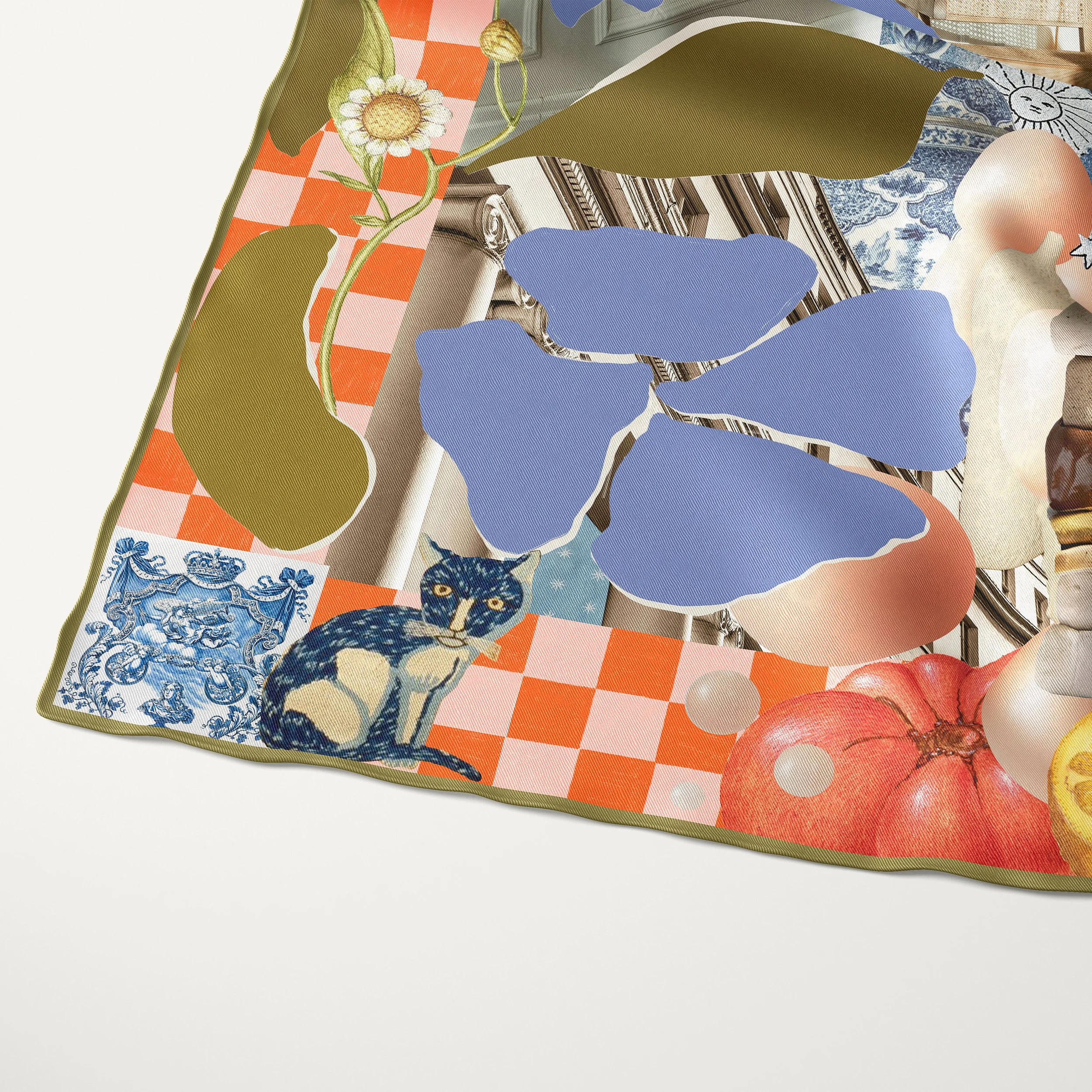 Image 2 of 2