
 Image 1 of 3
 Image 2 of 3
 Image 3 of 3
DETAILS
SET
3 rolled sheets
A1 594 x 841 mm
A2 420 × 594 mm
A3 297 × 420 mm
SIZE
PAPER
100 g/m², uncoated offset
FINISH
Matte
PRINTED IN
Germany
-
FREE WORLDWIDE SHIPPING ON ALL ORDERS
Orders are usually shipped within 2–3 working days, and international shipping is available.
Please note that customers may be subject to customs duties in their respective countries, which are their responsibility.
You can also pay directly via TWINT.
You’re also welcome to pick up your order directly from the studio in Meilen. Important: Please call or text ahead to arrange a pickup time. This ensures I’m at the studio and have your order prepared.
-
Handle with clean, dry hands to keep the print looking its best. Store flat in a drawer or re-roll and secure with a ribbon, not with tape. Keep away from direct sunlight to preserve the colours over time.
Read more here
PAY WITH TWINT
Somewhere between two old worlds, a road is waiting for you.
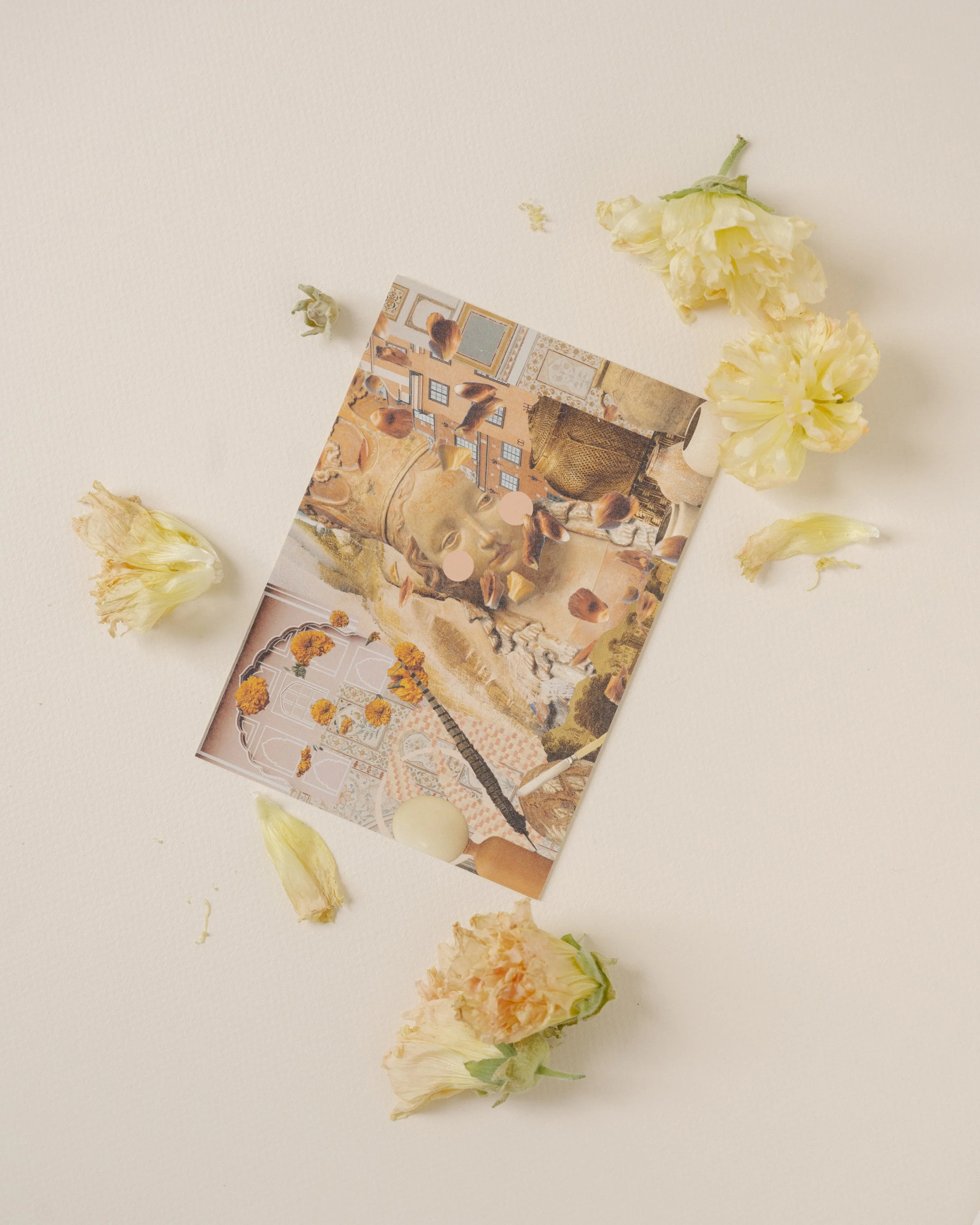
For this postcard, we found ourselves drawn to an old Norwegian tale, East of the Sun and West of the Moon, where a girl crosses impossible distances to break a spell cast on someone she loves. Marigolds, too, called us in, the flower used across Indian courtyards to mark thresholds and devotion, offered wherever one world meets another. Between these two traditions, one frost bound and windswept, one sun warmed and ceremonial, we found the shape of a single journey.
You cross the courtyard at dawn, when marigolds still hold the night's damp and the plaster walls blush pink under a sky the colour of weak tea. Petals fall from the vines above you, catching in your hair, scattering at your feet like small coins spent on a wish. The road ahead runs through orchards heavy with unripe fruit, then woodsmoke villages where dogs bark once and go quiet, then a coast where the houses wear ochre and rust like old coats against the wind.
You carry little: a loaf wrapped in linen, torn and shared with a stranger at a crossroads shrine who asks for nothing but company. A knife with a bone handle worn soft by other hands, used to cut rope from a gate long fallen shut, its hinges orange with rust. One thing you keep unlit, a stub of candle, pressed into your hand by your mother, who told you, light this only when you are certain, and even then, be careful what falls.
By midday the path climbs through a ruined garden, where vines have pulled half the stones down into the grass and left the rest leaning like old men. At its edge, where a stone face watches from beneath a broken crown, you pause. Its eyes have seen centuries of weather, of flowers offered and forgotten, of travellers who came this way and either turned back or did not. You press a marigold into a crack in the stone, the way travellers do when they mean to return, and for a moment the whole garden seems to hold its breath with you.
If you are reading this, you have already crossed something yourself, a distance, a threshold, a season. Keep the marigolds. You may need them for the way back.
PAIRS WELL WITH

PAY WITH TWINT
For most of human history, birthdays belonged only to kings and saints. Ordinary people were born, grew older, and said nothing particular about it. Most didn't even know their exact date. It wasn't recorded, wasn't kept. It wasn't until the industrial revolution that birth dates began to be written down for everyone. And once written down, they could be celebrated.
The candles came much earlier. In ancient Greece, people brought honey cakes to the temple of Artemis, goddess of the moon, the hunt, and of childbirth itself. The cakes were called amphiphon, meaning shining on both sides. Round like the moon, with candles placed all around the edge. It was not just a wish. It was a thank you. For the birth itself.
We kept the candles. We kept the wishes. We added the gifts. And somewhere along the way, we added the gift tag.
It is the last thing you do. The gift is chosen, wrapped, ribboned. And then you sit down with a small piece of paper and a pen and try to find the right words. Not many. There is no space for many. Just enough to say what you mean, in the handwriting that the other person will recognise before they have even read it.
It arrives first. Before the gift itself. The smallest part of the whole gesture. Written last, read first.
PAY WITH TWINT
Come, traveller. They say Aphrodite passed through here once, on her way up from the sea. That where her feet touched the ground, things grew. Citrus first, because she liked the smell of the rind on her fingers, and then the lilies, blazing up through the cobblestones as if the stone itself could not contain them.
You can still feel it, on a warm summer morning, when the market in Corfu is opening and the air is thick with the smell of fresh fruit. Somewhere between the stalls, an orange rolls free and no one stops it.
Follow it.
Past lemons piled in nets, still cool from the night. Past a window thrown open in an old building. The street narrows here, the stone worn smooth by years of the same footsteps, pilgrims, merchants, lovers, all of them following the same unhurried path.
Then the lilies. Tiger lilies, pushing up through a crack in the wall, orange against orange. Aphrodite's own flower, the Greeks said. The one that blooms where love has been.
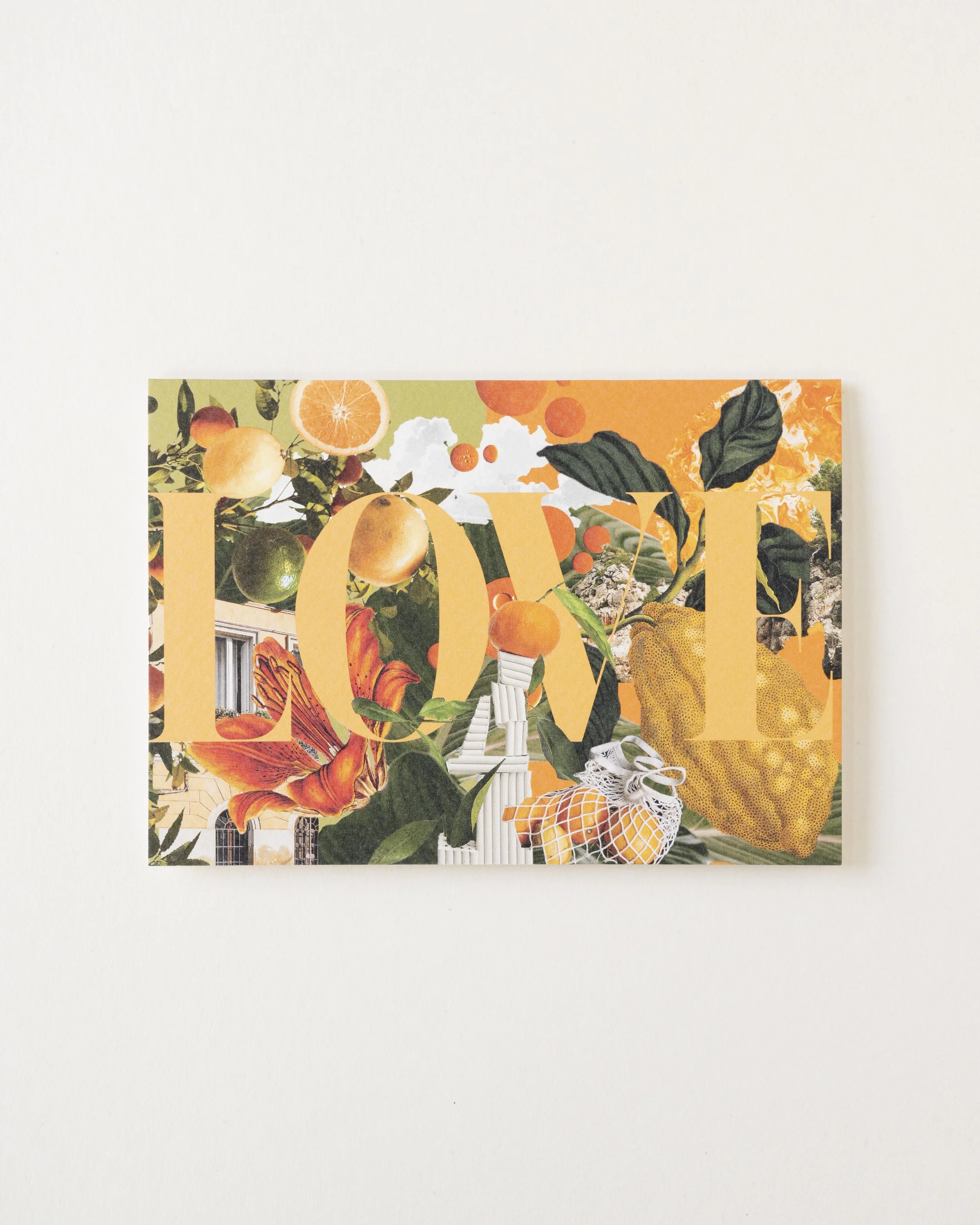
You stop. Above you, the sky has filled with fruit, oranges loose in the clouds, a lemon catching the light, the whole morning arranging itself into something you wish someone else could see. At the stall beside you, you find a card, the fruits, the lilies, that warmth, all of it gathered into one image, and across it a single word, wide and warm as the morning itself.
The card has already written itself. You just need to sign it.