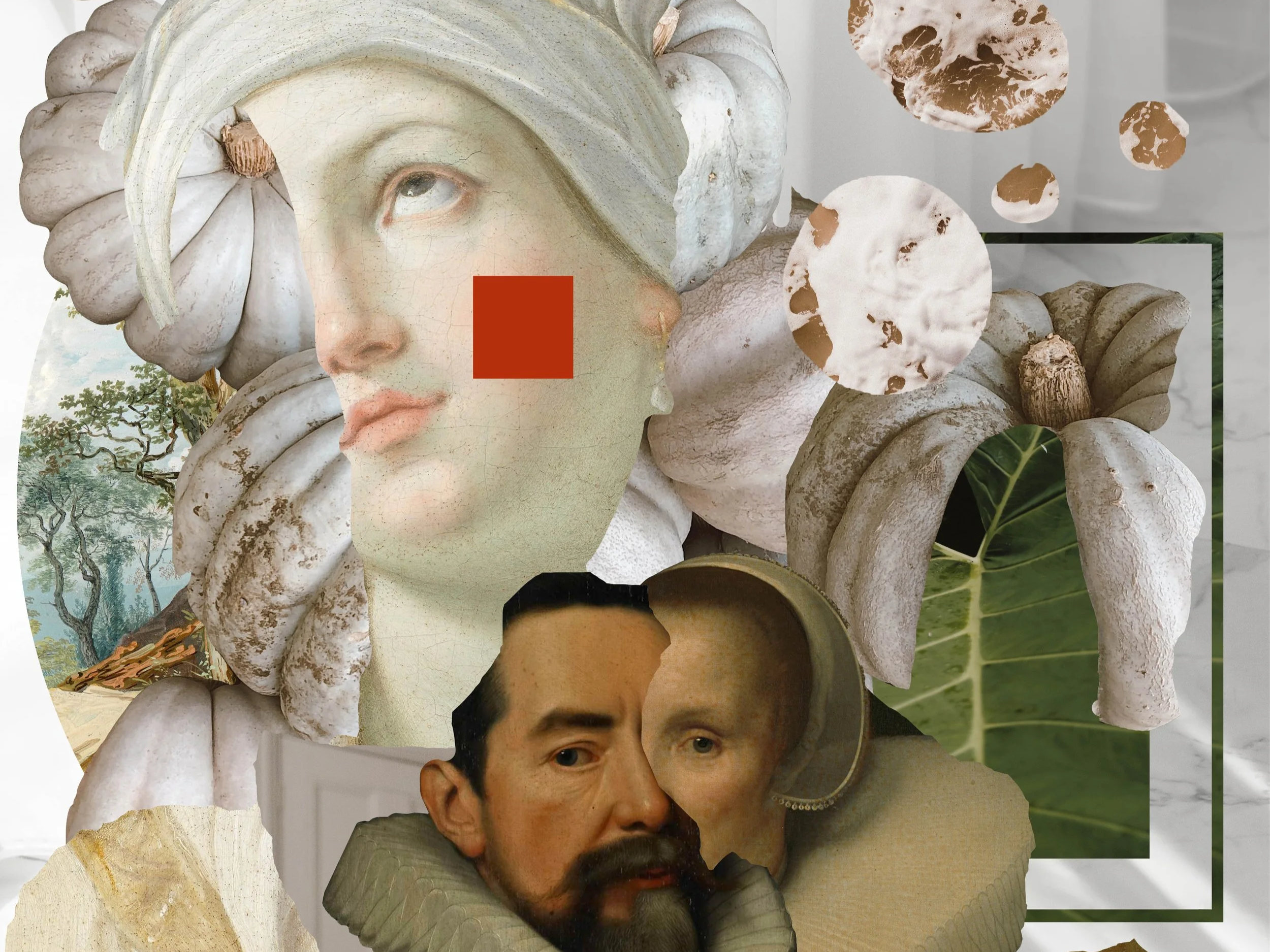
A CROWN IN THE STORM
The story behind the “A Crown in the Storm” wrapping paper collage.
The Throne of Caria
Stretching from the mountain belts of the Balkans to the Levant and as far as the Indus Valley, the ancient Achaemenid Empire included Caria in Anatolia. In the 4th century BC, the ruler of the region was Mausolus, who, after surviving an assassination attempt, died of unknown causes in 353 BC. His tomb in the city of Halicarnassus was so grand and marvellous that it was classified as one of the Seven Wonders of the Ancient World. The term “mausoleum” was named after him.
The successor to his throne was his wife, Artemisia II, who was distraught and who, according to Roman historical accounts, tried to transform herself into a living tomb. In a ritual that terrified the palace, she mixed Mausolus’ ashes in a glass of wine and drank his remains every single night. She believed his presence would stay in the material world in this way. During this mourning period, Artemisia, did not only have to face her husband’s untimely death, but also face her people’s disdain.
A Crown in the Storm
The island of Rhodes and other cities under her influence could not accept a woman on Mausolus' throne. The rumours of her peculiar mourning rituals had reached all cities of Caria, which made her look weak or even insane. In 351 BC, while she was experiencing grief, those who detested her rule rebelled against her. They launched a massive naval invasion to overthrow her and capture Halicarnassus, underestimating the strategic capabilities of a grieving widow.
The queen, however, was informed about their plans and orchestrated her defence in the shadows. While the Rhodians approached Halicarnassus, Artemisia ordered her fleet to enter a secret harbour which was situated near the royal palace. The main harbour appeared completely empty, giving the rebels the impression that the throne of Caria had no cover.
As the massive Rhodian fleet sailed toward Halicarnassus, Artemisia instructed her citizens to play along. As they all gathered at the city walls, they began clapping and cheering at the Rhodians, shouting signs of total surrender. The rebels felt at ease and lowered the defences, and, as they docked their warships, Carian infantry cut off the avenues of escape, surrounding the Rhodian forces. At the same time, the hidden fleet entered the main harbour, cutting off their exit from Halicarnassus.
At a time of grief, Artemisia showcased immense strength and power. She proudly wore her crown in the storm.
A Piece of the Puzzle
The widow’s peculiar ritual of grief and her turbulent reign have inspired countless artists over the years. Guido Reni's “Portrait of a Woman” (1638–1639) is a masterpiece featuring the widow wearing a turban and holding a bowl made of Lapis Lazuli, which contained Mausolus’ ashes. Her upwards gaze, a sign of her devotion and turbulent emotional state, dominates the wrapping paper collage design titled “A Crown in the Storm.” The collage is an ode to Baroque art, featuring different portraits from that era. It includes glimpses of Paul Sandby's The River Severn at Shrewsbury (1770), along with botanical elements, geometric shapes, and various textures that add an extra layer of visual interest to the scene.